
Categories
55+ Living, Downsizing Tips, SummerlinPublished August 22, 2026
Why Paid Off Doesn't Mean Free

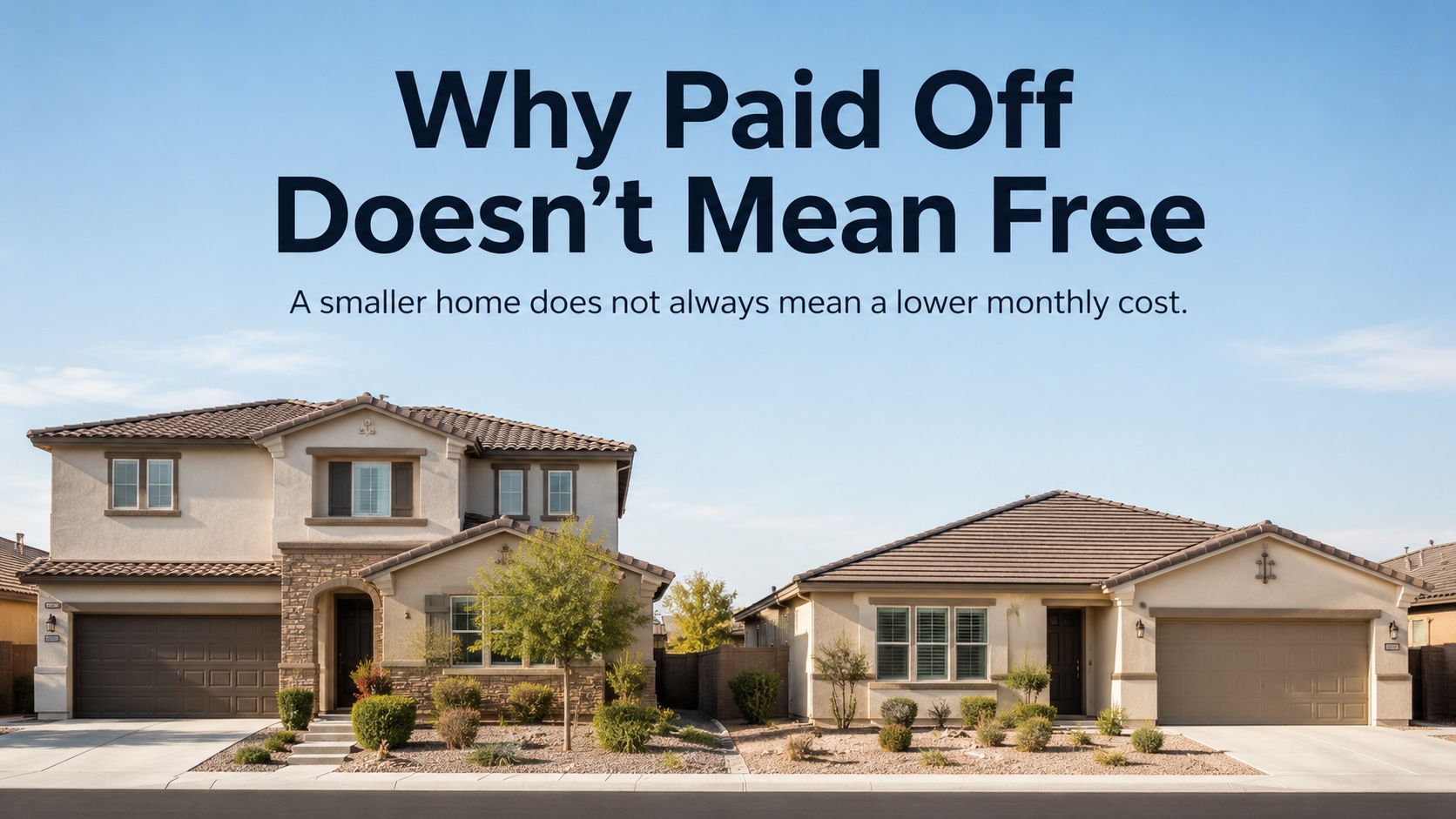
I was at a party last night and got pulled into a conversation I have almost every week, just in a different room. A man told me he's owned his two-story home since 2011. He's never refinanced, never pulled equity out, and he's still paying the same $1,300 a month he's paid for over a decade, taxes and insurance included. Now he's thinking about moving into a one-story home, and he had one question underneath all his other questions: is he about to trade a payment he knows for one he doesn't?
That's the real question behind "should I downsize." Not the square footage. Not the stairs, though the stairs matter too. The money.
I hear a version of this constantly, and it usually comes from two different directions. Some people are like the man at the party, sitting on a mortgage payment so low it feels almost silly to give up. Others are genuinely paid off, no mortgage at all, and they're wrestling with the same fear from a different angle: why would I take on a payment again when I don't have one now. Either way, the math question is identical, and most people never actually run it before they decide. They guess. I'd rather show you how to calculate it.
Why "Paid Off" Doesn't Mean "Free"
If your home is paid off, you no longer have principal and interest, but you still have property taxes, insurance, HOA dues if applicable, utilities, maintenance, and repairs. That's a real number, and it's easy to compare against nothing and assume any change is a downgrade. I've written before about the hidden costs of downsizing a Las Vegas home if you want the fuller list of what tends to catch people off guard.
But downsizing isn't really a comparison against zero. It's a comparison against what you'd do with the proceeds from selling your current home. If you sell a paid off house and buy a smaller one with cash, using the full proceeds, you might genuinely have no payment at all, just a smaller tax and insurance bill and lower maintenance. If you take some of those proceeds and invest or hold them back, and finance part of the new purchase, you're comparing a new payment against the opportunity cost of that cash, not against the zero you had before.
This is where the man at the party's situation actually helps illustrate the point, even though he isn't paid off. He locked in a payment years ago that today's rates can't touch. If he sells and buys a smaller home with a new loan at today's rates, his payment could go up even though his home got smaller, purely because of financing cost, not because a one story home is inherently more expensive. That surprises people every time. Smaller does not automatically mean cheaper once financing enters the picture.
The Rotheiser Comfort Zone Test
Here's where most people go wrong before they even get to a calculator. They fixate on the interest rate. They fixate on whether home prices feel too high right now. Neither one tells you anything by itself. A low rate does not make an unaffordable home affordable, and a higher rate does not automatically make an otherwise comfortable purchase a bad decision. The number I focus on most is the total monthly housing cost that comes out the other end.
This is what I walk every client through before we look at a single listing, and I call it the Rotheiser Comfort Zone Test. It starts with two numbers you set for yourself, not numbers a lender or a listing price hands you.
The first is your comfort number: the monthly payment you could pay without a second thought, the one that doesn't change how you live day to day. The second is your stretch number: the payment you could take on if the right home called for it, one that requires a little more discipline but doesn't cost you sleep or resentment six months later.
Once you have those two numbers, add up what the new home would actually cost you every month:
- New mortgage payment, if you finance any part of it
- Property taxes on that specific property
- Insurance
- HOA dues
- Estimated maintenance
Then compare that total against your comfort number and your stretch number, not against the rate you're quoted or the price on the sign. A home financed at a rate that sounds high can still land comfortably inside your zone. A home that looks like a deal on price can still push you past your stretch number once the full payment is added up. The rate and the price are just inputs. Your comfort zone is the output, and it's yours to define, not the market's.
One more piece belongs in this calculation, and it's the one people overlook most. Your sale proceeds don't have to go entirely toward the new home. If you're carrying credit card balances or other high interest payments, using part of the proceeds to clear those can widen your comfort zone just as much as a bigger down payment would. From a household cash flow standpoint, eliminating $400 a month in debt payments creates $400 of additional monthly room, the same as lowering your mortgage payment by that amount. How a lender treats those debts for qualification purposes is a separate calculation, and worth confirming with your lender directly. But for your own budget, when you run the numbers, look at your whole monthly picture, not just the housing payment sitting by itself. Sometimes the smartest move isn't the biggest down payment, it's restructuring what you owe.
The Nevada Piece Most People Miss
This is the part I want you to get right, because I see people talk themselves out of downsizing over a misunderstanding of how it works. Nevada does not reassess a home to its purchase price simply because it sells. That's how it works in some other states, but not here. The Clark County Assessor calculates a property's taxable value under Nevada's statutory system, based on land value plus the replacement cost of improvements, minus depreciation, not what you paid for it.
What you also need to check after a sale is the property's tax cap status. Under Nevada law (NRS 361.4723), a qualifying owner-occupied primary residence gets its annual tax bill increase capped at no more than 3 percent. Other property, including homes that aren't owner occupied, generally falls under a cap of up to 8 percent. Following a purchase or qualifying ownership change, Clark County sends residential property owners a Tax Cap Abatement Notice so the appropriate tax cap status can be established (Clark County Assessor, Tax Abatement). So the future tax bill depends on the taxable value of that specific property, its applicable abatement, and the buyer's eligibility for the owner-occupied tax cap. It should be verified for the individual parcel rather than estimated from purchase price or square footage. A smaller, older home could tax lower than what you're paying now. A different property with a higher taxable value could tax higher. Size alone doesn't tell you which way it goes.
New construction works differently. A newly built home doesn't qualify for either tax cap during its first fiscal year. The appropriate cap, 3 percent or up to 8 percent, begins the following year (Clark County Assessor, Tax Abatement). If you're comparing a resale home to new construction, that first year gap is worth putting in your spreadsheet.
Insurance can move the other direction, though it depends on more than size. A smaller or newer single story home might cost less to insure than an older two story home, depending on the property, roof, construction, coverage, claims history, and insurer. It's worth getting an actual quote rather than assuming. Maintenance tends to drop with a smaller, newer home, but not automatically either. Less exterior to maintain and fewer systems help, and for a lot of my clients the real win is no more stairs to worry about as they get older. That part isn't financial, but it's real, and it's usually the actual reason someone starts this conversation in the first place.
Check Your Tax Cap After You Move
There's another reason I tell buyers to check the tax record after they move, and it's something I've caught for clients more than once. Nevada allows only one property to be treated as your primary residence for the 3 percent tax cap. If you buy your next home before selling your current one, or if the ownership information changes during a purchase or a title change sometimes associated with a refinance, it's worth confirming that Clark County has the new home classified correctly.
I've had clients discover their property was showing an 8 percent cap when they believed, correctly, that they qualified for the 3 percent owner-occupied cap. They had no idea until we looked up the property record together. I've seen it happen more than once, usually after a purchase or ownership change when the tax cap information was not recorded as the homeowner expected.
Clark County allows homeowners to correct an incorrect tax cap designation. For the 2026 to 2027 tax year, the county currently gives homeowners until June 30, 2027 to make that correction. Once the property is established as your qualifying primary residence, Clark County says the 3 percent cap continues for future billing years unless the ownership on the parcel changes (Clark County Assessor, Tax Cap Information).
This is why I tell homeowners to check the tax cap percentage on the new property rather than assuming it was recorded correctly. It takes only a few minutes to look up, and an incorrect 8 percent designation can affect what you pay over time. It's a quick check I run for clients as a matter of course.
Sell First or Buy First
This is the second half of the question the man at the party asked me, and it's the one that actually keeps people up at night. Do you sell your current home first and then go find the next one, or do you buy first and sell after?
Selling first is the lower risk path financially. You know exactly how much you have to work with, you're not carrying two properties, and you're negotiating your purchase as a strong buyer with cash in hand rather than a contingent one. The tradeoff is logistics. You may need to move into a rental or stay with family for a stretch while you find the right single story home, especially in communities where the inventory you actually want doesn't turn over that often.
Buying first solves the logistics problem but adds financial pressure. You're either qualifying for a new payment while still carrying your old one, or you're leaning on some form of bridge financing, a short term loan or equity access product that lets you tap the equity in your current home before it sells so you can move on the new purchase without waiting. These products exist and more lenders are offering them, but the terms, costs, and qualification requirements vary a lot from lender to lender. I'd never tell a client which one to use without them talking to a lender directly and reading the actual terms, but I can tell you it's worth asking about if the buy first path fits your situation better than the sell first one.
There's no universally right answer here. It depends on how much cushion you have, how competitive the inventory is in the community you're targeting, and honestly, how much uncertainty you can live with for a few months.
The Client Story
The man at the party isn't a client yet, but I've had this exact conversation with people who are. One couple I worked with had owned their two-story home since the early 2010s, similar to his situation, with a payment in the same range, right around $1,300 a month. They were terrified that downsizing meant a worse deal. We started with their comfort number and their stretch number, then ran the Comfort Zone Test on a few real homes: what their current home would likely sell for, what a single story home in their range would actually cost once you added the tax bill for that specific property, and what the resulting payment looked like if they financed a portion instead of paying cash. Once they saw the actual payment sitting comfortably inside their own number, not the rate, not the price tag, the decision got easier. They stopped guessing and started deciding with real numbers in front of them.
The Bottom Line
Downsizing a paid off home is not automatically a smart move or a bad one, and anyone who tells you otherwise before running your actual numbers is guessing. Whether you're truly paid off or sitting on an old low payment like the man I met last night, the question is the same: what does the new home actually cost you once you factor in the sale, the financing, the taxes, and the way you plan to sequence the move. Run it before you decide, not after. If you'd like help running your own numbers, you can start by browsing single-story homes for sale in the Las Vegas area.
Frequently Asked Questions
Will my mortgage payment go up if I downsize to a smaller home?
It depends entirely on how you finance the purchase, not just the size of the home. If you buy with cash from your sale proceeds, you may have no payment at all. If you finance part of the purchase at today's rates, your payment could be higher than an old, low rate mortgage even though the home is smaller, because interest rates have a bigger effect on payment than square footage does.
If my home is already paid off, why would I ever take on a new payment?
You wouldn't have to. Most people who are truly paid off and downsize can buy a smaller home outright with their sale proceeds and stay payment free. The decision usually comes down to whether you want to keep some of that equity liquid rather than putting all of it into the next house, which is a personal choice, not a requirement.
Should I sell my current home before I buy the new one?
Selling first is the lower risk option financially because you know your exact budget and can make a stronger offer on the next home. Buying first avoids the stress of moving twice but usually requires either carrying two properties briefly or using bridge financing to access your equity before the sale closes.
What is bridge financing and is it worth using?
Bridge financing lets you tap the equity in your current home before it sells, so you can buy your next home without waiting for your old one to close. It can solve the sequencing problem, but terms and costs vary by lender, so it's worth having that conversation directly with a mortgage professional before deciding it's the right tool for your situation.
Will my property taxes go up if I buy a smaller home in Nevada?
It depends on the specific property, not the size. The future tax bill depends on the taxable value of that particular home, its applicable abatement, and your eligibility for the owner-occupied tax cap under Nevada law (NRS 361.4723, Clark County Assessor). It should be verified for the individual parcel rather than estimated from purchase price or square footage. New construction is the exception, since it doesn't qualify for either tax cap during its first fiscal year.
Does Nevada reassess a home to the purchase price when it sells?
No. Unlike some other states, Nevada does not reset a property's taxable value to the sale price. The Clark County Assessor calculates taxable value under the state's statutory formula, land value plus the replacement cost of improvements, minus depreciation. Following a purchase or qualifying ownership change, Clark County sends residential property owners a Tax Cap Abatement Notice so the appropriate tax cap status can be established, but the taxable value itself isn't reset to what you paid.
What is Nevada's 3 percent property tax cap?
Under NRS 361.4723, a qualifying owner-occupied primary residence gets its annual property tax bill increase capped at no more than 3 percent. Property that isn't owner occupied, along with land, commercial buildings, and other property types, generally falls under a cap of up to 8 percent instead. New construction doesn't qualify for either cap during its first fiscal year, and the appropriate cap begins the following year.
How do I know if my Nevada home has the 3 percent or 8 percent property tax cap?
Check the property with the Clark County Assessor and confirm the home is being treated as your qualifying primary residence. I recommend checking after a purchase or ownership change rather than assuming the designation was recorded correctly. I've helped clients identify properties showing an 8 percent cap when they actually qualified for the 3 percent owner-occupied cap. Clark County allows homeowners to request a correction when the tax cap designation is wrong, and for the 2026 to 2027 tax year, homeowners currently have until June 30, 2027 to make that correction.
Should I put all my sale proceeds toward the down payment on my next home?
Not necessarily. A bigger down payment isn't the only way to make a new home more affordable. If you're carrying credit card debt or other high interest payments, using some of your proceeds to pay those off can free up as much monthly room as a lower mortgage payment would, sometimes more. It's worth running both scenarios, a bigger down payment versus a smaller one paired with debt payoff, before deciding where the money goes.
Is a single story home actually cheaper to maintain than a two story home?
Often, but not automatically. It depends on the age and condition of each home, the roof, the HVAC system, landscaping, pool equipment if there is one, and what maintenance responsibilities the HOA takes on versus what falls to you. What's consistently true for a lot of my clients is the physical relief of losing the stairs, even in cases where the maintenance cost itself doesn't change much. That's usually the reason the conversation starts in the first place, even when the financial math is the harder part to work through.
Scott Rotheiser, Nevada Real Estate Broker, License #B.1003211, specializes in 55+ communities, downsizing, single-story homes, and active adult living in Summerlin, Henderson, and the greater Las Vegas area.
Since 2011, Scott has been involved in the sale of more than 1,500 homes across the Las Vegas area, spanning a wide range of buyers, sellers, and property types. Today, his work focuses on 55+ housing, active adult communities, downsizing, new construction considerations, and helping clients understand how housing decisions fit into long-term lifestyle planning.
Visit scottrotheiser.com to learn more.
Sources
- Clark County Assessor, Tax Abatement (owner-occupied 3 percent cap, other property up to 8 percent cap, new construction first-year exception)
- Clark County Assessor, Tax Cap Information (correcting an incorrect tax cap designation, deadlines)
- Nevada Revised Statutes 361.4723, Partial Abatement of Taxes
- Nevada Department of Taxation
This article summarizes general information for educational purposes and is not legal, tax, or financial advice. Consult a licensed lender, tax professional, or attorney for guidance specific to your situation.
```

Scott Rotheiser
| H Scott Rotheiser
or another way